Self-Sufficient Early Warning Fire System
Solo project: research, part selection, wiring, code, enclosure design and 3D printing, and testing
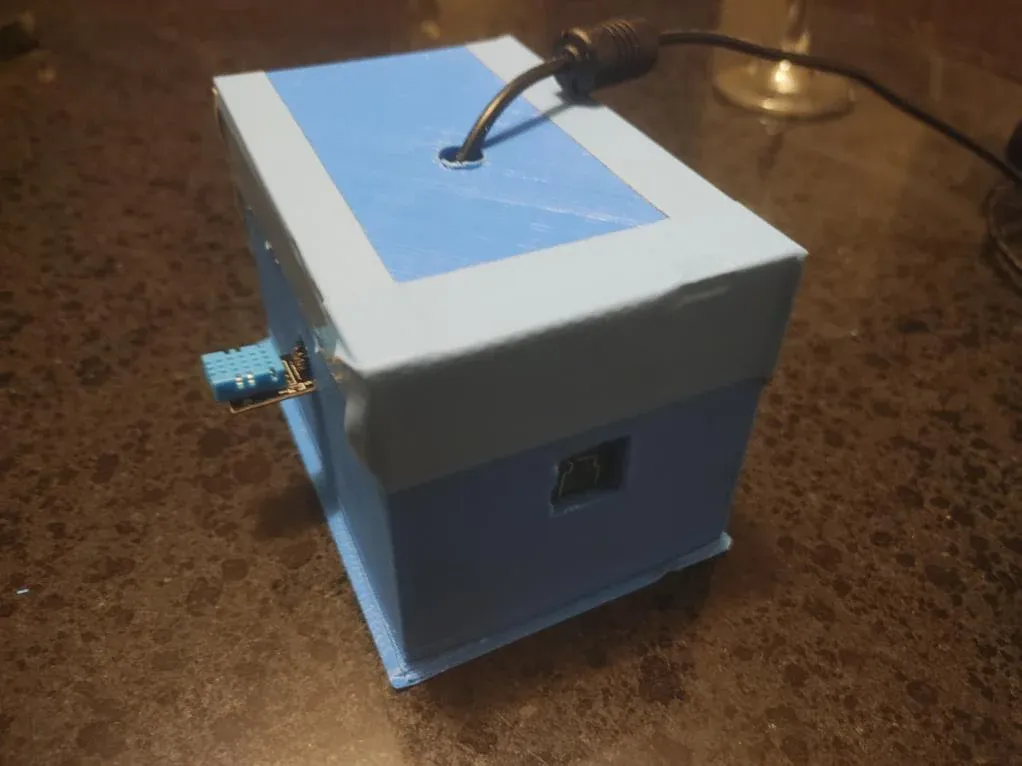
Built a Raspberry Pi detector with a camera and temperature, humidity, and gas sensors in a 3D-printed enclosure, and tested it against a campfire. Smoke was visible in the camera images from about 80 feet, and the temperature sensor registered a change of about 5 C over a 25 foot approach.
Objective
Can affordable technology detect a wildfire before it becomes uncontrollable? The early warning systems I found were either expensive camera towers built for fire agencies or satellite data meant for fire managers. I wanted a small, self-sufficient device that people in high-risk areas, like campsites, farms, and homes, could put on a pole or treetop, and that would compare its readings with other nearby devices to catch a temperature spike in one area.
Approach
The first prototype was built around an Arduino. I studied the programming books but could not get the sensors to work, and after more research I found there was more support for the Raspberry Pi, with interchangeable sensors, so the second prototype moved to a Raspberry Pi 3 with a PiCamera, a temperature and humidity sensor, a combustible gas sensor, a cellular modem, and a PiJuice hat with a solar panel for power. I priced both prototypes; the second came to about $260 per unit.
I wrote up the parts, wired the sensors, adapted Python code for temperature logging and time-lapse photo capture, and designed a 3D-printed box with a window for the camera, holes for the cables, and a hole in the base so the unit could later sit on a rotating pole.
Results
For the smoke test I set the camera to take a photo every minute instead of every ten and lit a small campfire. The smoke was easy to pick out in the images from about 80 feet, and the camera resolved detail much farther than that. For the temperature test I moved the device 5 feet at a time along a 25 foot line, first away from the fire and then back toward it. The sensor showed about 5 C of change and humidity dropped closer to the fire, so it works, but it is much less useful than the camera and would need work to be accurate.
What I would do next
Add the solar panel to the prototype so it is truly self-sufficient, connect the Raspberry Pi to the internet and write the code to transmit readings and manage the photo files, and re-evaluate the temperature sensor. This was the first project where I went from an idea to a built, tested device on my own, and it is what started me on engineering.