Uncertainty Analysis of Five Flow-Measurement Devices
Lab experiment and report: collected the measurements with my lab group, then did the uncertainty calculations and wrote the report
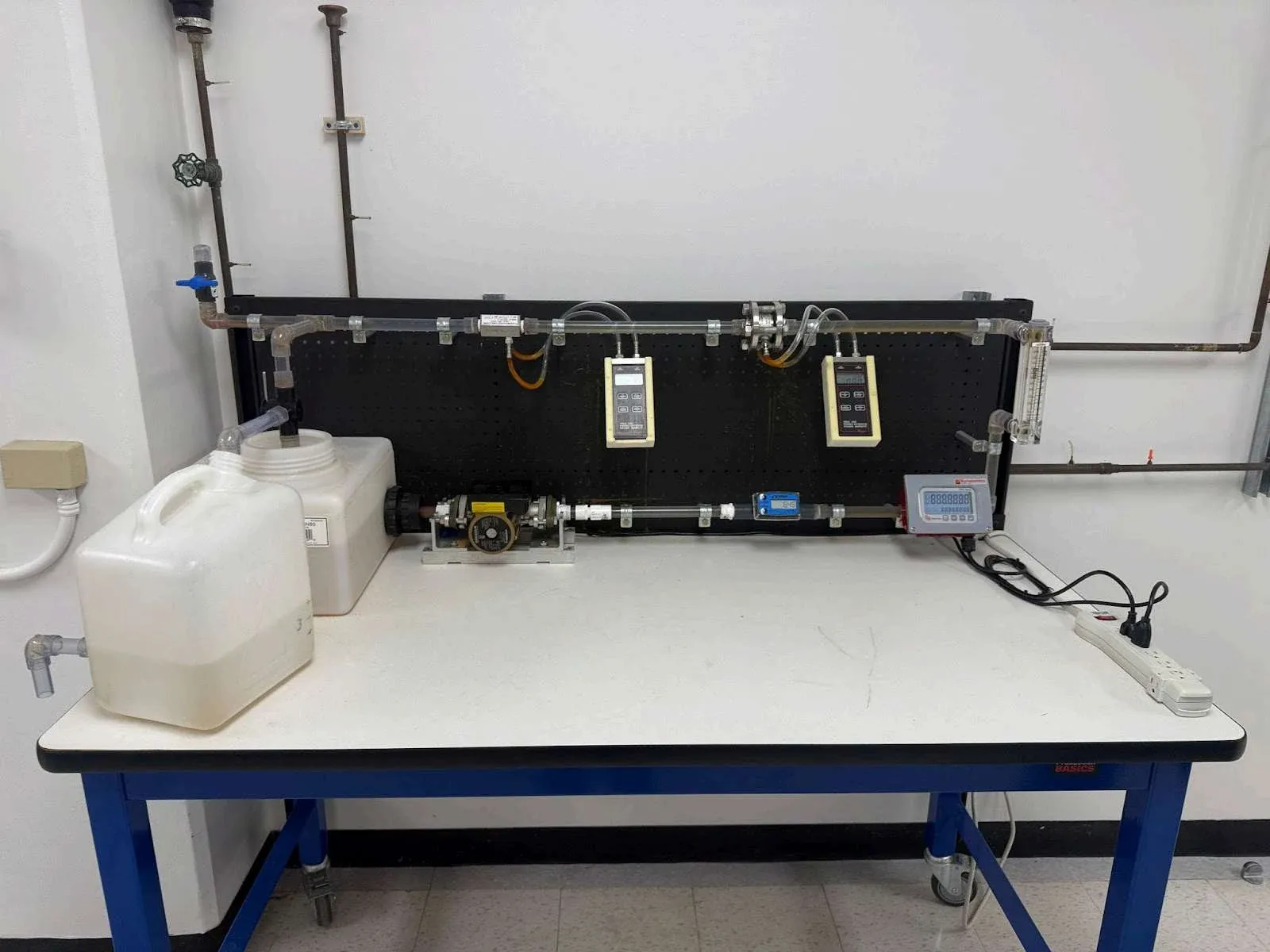
Compared venturi, orifice, rotameter, turbine, and ultrasonic flow meters against a bucket-and-stopwatch reference, using uncertainty propagation to rank how closely each device matched the actual flow rate.
Objective
Five different flow meters were installed on the same closed water loop. The question: how close does each one come to the true flow rate, and how much should you trust each reading? The true rate came from the simplest possible reference: timing how long the loop takes to fill a bucket.
Method
We ran the loop at a low and a high flow rate and took ten readings from every device at each. For each meter I calculated the mean, standard deviation, and a 95% confidence interval, then combined the measurement scatter with each instrument’s stated accuracy to get a total uncertainty. The venturi and orifice readings also had to be converted from pressure differentials to flow rates using the Bernoulli equation.
Results
The rotameter came closest to the reference at both flow rates. The orifice meter consistently read low by a noticeable margin. The main takeaway wasn’t the ranking itself but the method: without the uncertainty analysis, all five meters look equally believable, and the analysis is what shows which readings deserve trust.