Renewable Energy Systems

Solar Desalination and Hydrogen Electrolysis System

A low-cost floating device that produces fresh water and renewable hydrogen from salt water

2022-2023 · Independent research · Genius Olympiad International 2023

Solo researcher: designed, built, and tested the full system, including CAD modeling and 3D printing the custom electrolysis chamber
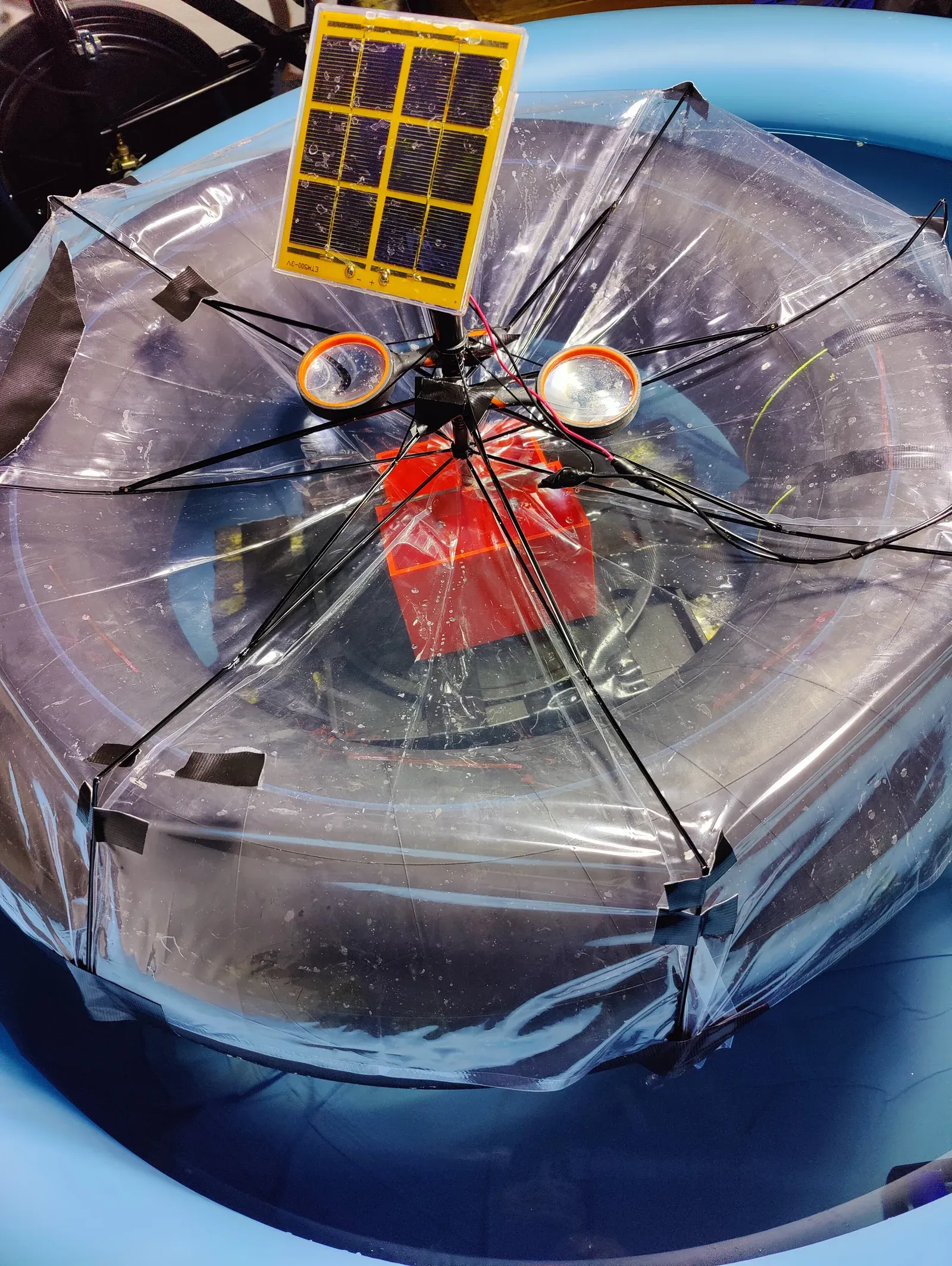
Floating desalination prototype in a test pool: an inverted clear umbrella frame with taped film panels, a small solar panel mounted at the center mast, and the red 3D-printed electrolysis chamber visible beneath the film
Result

An optimized 3D-printed electrolysis chamber cut hydrogen production time from 51.66 hours to 356.51 minutes per liter, earning a Bronze Medal at Genius Olympiad International 2023.

8.7x faster hydrogen production after chamber redesign
356.51 min to produce ~1 L of hydrogen, down from 51.66 hours
Bronze Medal, Genius Olympiad International 2023 (Project ID 3042)

Objective

The optimized system produced roughly 1 L of hydrogen in 356.51 minutes, an 8.7x improvement over the 51.66 hours the first configuration needed, and the project earned a Bronze Medal at Genius Olympiad International 2023. Over 40 percent of the global population lacks reliable access to clean water, and desalination plants are expensive and energy intensive. My goal was to design, build, and test a low-cost floating device that handles two jobs at once: desalinating salt water into drinkable condensate and running electrolysis to generate hydrogen gas as a storable renewable fuel. This was independent solo research, so every design decision, build, and trial was mine.

Approach

The prototype used a clear umbrella frame covered in film as the condensation surface, with solar panels on a central mast, thermal insulation, and wiring running to submerged electrodes. Testing happened in a 300-gallon pool mixed to a 3.5% salt solution, with a 1000 W grow light on a 12-hour cycle standing in for sunlight. Desalination trials measured condensate collected over day and night cycles; when the first umbrella orientation gathered water in the wrong spot, I reversed it and collected significantly more. Electrolysis was the bigger problem. The initial setup took 51.66 hours to fill a 1 L container with hydrogen, so I CAD modeled a custom electrolysis chamber in Tinkercad and FDM 3D printed it: a central tube holding eight coiled-copper electrodes, fed by four solar panels, with a threaded port for a collection bottle. Iterative testing across five experiment series drove each revision.

Outcome

The redesigned chamber brought hydrogen production down to 356.51 minutes per liter, an 8.7x gain over the original wiring and electrode layout. I presented the work at Genius Olympiad International 2023 (Project ID 3042), where it received a Bronze Medal, and again at the STANYS New York State Science Congress in June 2023. The project convinced me that careful geometry and electrode design matter as much as raw power input, a lesson I’ve carried into every build since.

Concept → Reality

Floating desalination prototype in a test pool: an inverted clear umbrella frame with taped film panels, a small solar panel mounted at the center mast, and the red 3D-printed electrolysis chamber visible beneath the film
Tinkercad CAD model Built & tested prototype

Figures

The floating prototype during pool testing: an umbrella-frame condensation surface with a mast-mounted solar panel and the 3D-printed electrolysis chamber submerged in the 3.5% salt solution.
Floating prototype in the 300-gallon test pool, built from an umbrella frame, clear film, a central solar panel, and the red 3D-printed electrolysis chamber below

The floating prototype during pool testing: an umbrella-frame condensation surface with a mast-mounted solar panel and the 3D-printed electrolysis chamber submerged in the 3.5% salt solution.

Tinkercad model of the custom electrolysis chamber, designed with a central tube and mounts for eight coiled-copper electrodes before FDM 3D printing.
Tinkercad CAD model of the custom electrolysis chamber, showing the circular housing with internal electrode mounts and side ports

Tinkercad model of the custom electrolysis chamber, designed with a central tube and mounts for eight coiled-copper electrodes before FDM 3D printing.

The printed chamber during bench testing, with an inverted bottle attached for hydrogen collection and volume measurement.
The red FDM 3D-printed electrolysis chamber on a countertop with an inverted clear plastic bottle seated in its collection port

The printed chamber during bench testing, with an inverted bottle attached for hydrogen collection and volume measurement.

Presenting the project and hardware at the STANYS New York State Science Congress, June 2023.
Alexia standing beside her research poster and hardware at the STANYS New York State Science Congress, with solar panels and the red electrolysis chamber on the table

Presenting the project and hardware at the STANYS New York State Science Congress, June 2023.