YETI Bottle Deconstruction and CAD Documentation
Created the lid multiview technical drawing, measured component dimensions, and built the Fusion 360 models and drawing sheets for the lid and both assemblies on a 5-person team
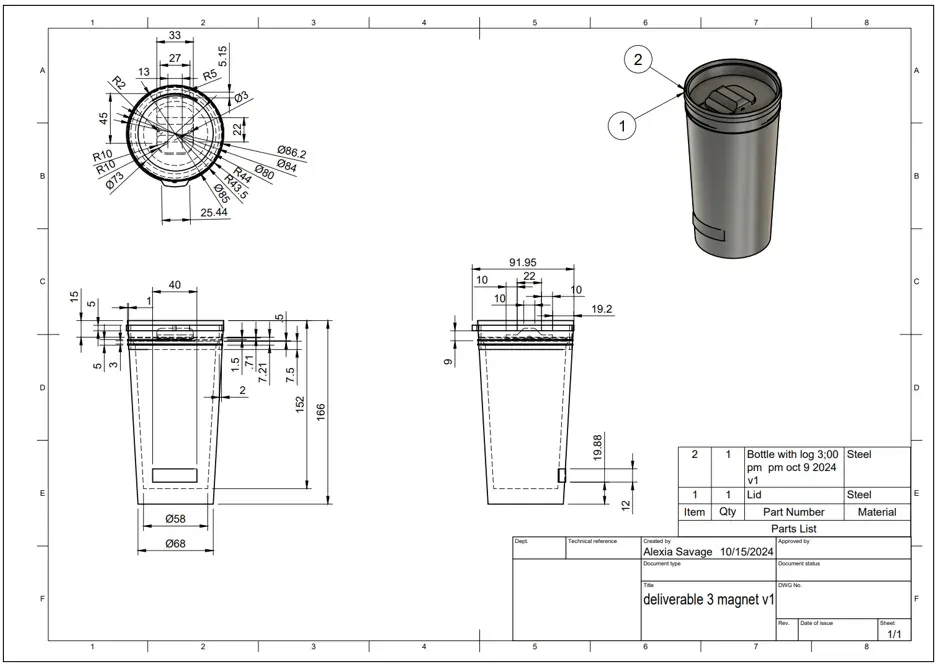
Produced a complete technical documentation package for a 3-part YETI bottle, from hand-drawn multiview drawings to fully dimensioned Fusion 360 drawing sheets with an exploded assembly and parts list.
This project turned a physical YETI bottle into a complete set of engineering documentation: photographic drawings, hand-drawn multiview drawings, and fully dimensioned Fusion 360 drawing sheets, finishing with an exploded assembly and parts list. My name appears as creator in the title blocks of the assembly, lid, and cup drawings.
Objective
For ECOR 1047 (Engineering Design and Visual Communication), our five-person team deconstructed a three-part consumer product, a YETI water bottle measuring 88 mm wide, 91 mm deep, and 171 mm tall, and documented it through the full design-communication workflow: physical object, 2D hand-drawn technical drawings, and accurate 3D CAD models and assemblies in Fusion 360.
Approach
I measured the component dimensions from the disassembled bottle and created the lid multiview technical drawing by hand on an A3 sheet at 1:1 scale, with dimensioned top, front, and side views plus an isometric sketch. Those measurements became the basis for the CAD phase. In Fusion 360 I modeled the lid and built both assemblies, then produced the drawing sheets: a lid component drawing with diameter, radius, and section callouts, a cup drawing with orthographic views and a shaded isometric, and a full assembly drawing with balloon callouts tying each part (bottle, lid, and magnet slider) to a parts list with materials. Each sheet carries a standard title block, scale, and sheet numbering.
Outcome
The finished package documents all three components across roughly 25 pages, moving from photographs through hand drawings to dimensioned CAD sheets that another student could rebuild the product from. Beyond the deliverable itself, the project built habits I now apply by default: measure before you model, keep hand drawings and CAD dimensions consistent, and treat the title block and parts list as part of the engineering, not decoration. It stands as my strongest university evidence of CAD modeling and technical drawing to standard.